The following information is a basic guide to bonsai care that Maruen provides to customers when they purchase a bonsai.
Casual bonsai
Daily care Essentials
If you take into consideration that "Casual Bonsai" is a plant that needs sunlight and sufficient water, you will enjoy taking care of it on a daily basis and will feel like you can have a dialogue with it.
1.Where should they be placed?
It should not be placed indoors only, but it should also be put out in a sunny and well-ventilated place.
Bonsai is also a plant, so it prefers sunlight and air flow.
(1)The most desirable location is "outside."
In summer, "half-shade" with a few hours of sunlight in a day is good. In winter, place them under the eaves or on a balcony in full sun to avoid root damage.

(2) Points to keep in mind when placing the product indoors.
Do not expose them directly to the wind of air conditioning indoors.
Rotate the placement of the plants between indoors and outdoors to expose them to sunlight, outside air and wind.
(e.g., indoors for 2 days ⇒ balcony for 2 days ⇒ indoors for 2 days)
2.How/when to water?
Water slowly and gently over the entire surface of the potting soil from the mouth of a water jug, jar or plastic bottle.
If water flows out of the bottom hole of the pot, it means that the pot is well watered.

Water the potting soil before it dries out.
-
Spring and Fall→One time in one day is basic
-
Summer→Twice a day is best
-
Winter→One time in two to three days is basic
After watering, wait for the water to stop flowing from the bottom hole of the pot and place it on a decorative plate or dish for safe indoor viewing.
3.Recommended nutrient supplements
Supplementing nutrients helps new root development and makes the plants more tolerant of heat, cold, and other stresses.
It is recommended to dilute Menedael (commercially available at garden supply stores and home centers) to 100 times and give it once a week.
(The diluted solution can be stored in a plastic bottle.)
100ml undiluted solution Around 600 yen ▶
Below are some of the questions and answers that Maruen most often receives from customers when selling bonsai.
Q1: What does Maruen consider to be “good bonsai care”?
Bonsai can stay healthy with three basic elements: sunlight, water, and pruning
(pruning means cutting back overgrown branches and thinning crowded leaves).
In addition to these, treating the plant gently and with care is enough to enjoy a relaxed and rewarding life with bonsai.
Q2: Can bonsai be grown indoors only?
If a bonsai is kept indoors all the time, photosynthesis may become insufficient.
This can cause the tree to lose vigor, leaves to become less colorful, and the number of leaves to decrease.
Even sunlight through a window does not provide enough light over time.
It is best to place the bonsai in direct sunlight occasionally, even if not every day.
Exposure to natural outdoor air and breeze also helps bonsai grow more actively and encourages new buds.
Q3: Is it normal for bonsai to change its appearance with the seasons?
Yes, seasonal change is natural for bonsai.
Both evergreen and deciduous trees grow new branches and leaves in spring and summer.
Deciduous trees change color in autumn, drop their leaves as temperatures fall, and produce new buds in spring.
Bonsai allows you to experience the rhythm of the seasons within a single pot.
Q4: Do insects appear on bonsai?
Because bonsai are living plants, insects may sometimes appear.
However, the risk can be reduced through proper care.
From May to July, humidity in Japan is high.
During this period, pruning overgrown branches and thinning crowded leaves improves air circulation and helps prevent insects.
If insects do appear, they can be treated with plant-safe insecticides available at garden shops.
Q5: How long can bonsai be enjoyed?
With proper care, bonsai can continue growing for 10 years or even several decades.
About once every 3 to 4 years, repotting is recommended.
This involves removing the tree from the pot, trimming about 10% of the old roots, and replacing a similar amount of soil.
Repotting refreshes the roots and supports healthy long-term growth.
Q6: Isn’t pruning grown branches and leaves cruel to the plant?
Nutrients absorbed by the roots travel through the trunk and reach the branches and leaves.
By pruning and limiting the amount of branches and leaves, nutrients are concentrated more effectively within the tree.
As a result, nutrients also accumulate in the trunk.
Over time, the trunk thickens, and the tree becomes stronger and more stable within the pot—
not only improving its appearance, but also shaping it into a well-balanced and resilient bonsai.
Q7: Are there special precautions for midsummer and midwinter care?
Bonsai enjoys sunlight and natural airflow, but extreme heat and cold can cause stress.
In midsummer, when temperatures exceed 35°C (95°F),
it is better to avoid prolonged direct sunlight and manage the bonsai in a shaded, well-ventilated area.
In midwinter, when temperatures fall below 4°C (39°F),
place the bonsai indoors or in a protected outdoor space where cold wind is blocked by walls or boards.
This helps prevent damage to the roots.
Both providing sunlight and protecting the plant from harsh conditions are important aspects of bonsai care.
Experience Traditional Japanese Rural Culture at Maruen


Maruen is located about 25 km from Tokyo, in Midori Ward, Saitama City.
Surrounded by nature and farmland, you can relax in a traditional rural setting while experiencing Japanese culture and the changing seasons.
The experience begins with making udon noodles by hand, a food deeply familiar to everyday life in Japan.
You will then boil the noodles yourself and enjoy them as lunch.
After lunch, you will take part in a bonsai-making experience, planting a young tree into a small pot while learning basic care and discovering the Japanese sense of nature and aesthetics.
(Participants living in Japan may take the bonsai they create home with them.)
Udon & Bonsai Making:
One-Day Experience
You will make udon yourself, a dish traditionally served as hospitality to guests in rural communities and passed down in the Maru family.
You can check the location of Maruen using this link.
Udon-making experience


The dough is kneaded firmly with your body weight using your feet, rolled out with a rolling pin, and cut into easy-to-eat noodles.
The finished noodles are boiled on the spot and enjoyed fresh. You can adjust the soup to your own taste and add your preferred toppings.
Even with the same method, the texture and flavor turn out slightly different for each person.
Bonsai-making experience


You can choose your favorite combination from 3–4 seasonal seedlings and pots. By working with your hands, you will complete one unique piece and take it home.
In addition to being simply fun, this experience also helps you understand repotting in the future as your bonsai grows and its roots develop.
By bringing together separate elements such as the tree and the pot with your own intentions, you can enjoy a calm, creative moment that feels completely different from everyday busyness and stress.
Experience Dates
Daily Schedule
※ Reservations are accepted for a minimum of two people (two meals).
※If you have any questions, please contact us by email in English, and we will reply in English。
Experience Dates
Mar 11,2026 | 10:30 a.m. – 5:00 p.m.
Mar 19,2026 | 10:30 a.m. – 5:00 p.m.
Apr 16,2026 | 10:30 a.m. – 5:00 p.m.
Apr 18,2026 | 10:30 a.m. – 5:00 p.m.
Apr 27,2026 | 10:30 a.m. – 5:00 p.m.
Experience Dates
10:30 a.m.
Udon Making Experience Begins
12:00 a.m.
Cooking & Tasting Your Udon
You will boil the udon you made, add toppings, and enjoy your meal.
After the meal, there will be a break time, during which you can explore the facilities at Maruen.
2:15 p.m.
Bonsai Making Experience Begins
5:00 p.m.
End of Bonsai Making Experience
One-Day Experience Fee
Bonsai & Udon Making Experience
8,100yen per person
(tax included)
Children aged 6 and over are charged the same rate as adults.
Children under 6 are also charged the adult rate if a full meal is required.
We do not have multilingual staff, but we will use a translation device during the experience.
Participation fees may be subject to change without prior notice.
Reservation Process
1. Submit a Tentative Reservation
Please check the available candidate dates and submit your application via the Udon Making Experience Tentative Reservation Form.
Please note that this does not confirm your reservation for the selected date.
STEP
01
2. Availability Confirmation & Payment
Our staff will contact you regarding the availability of your requested date.
If the date is available, we will send you an email with payment instructions, including a bank transfer option and a credit card payment link.
Please complete the payment using your preferred method.
STEP
02
3. Reservation Confirmation
Once your payment has been completed, we will send you a reservation confirmation email.
We look forward to welcoming you on the day of the experience. Please have a safe trip!
STEP
03
Udon Making Experience Flow

01
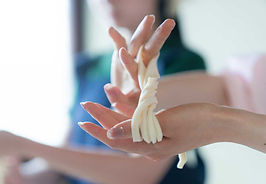
Using your body weight, you will step on the round udon dough to develop the chewy texture of the noodles.

02
Using a rolling pin, you will roll out the udon dough, checking for thick and thin areas and smoothing it evenly.

03
You will shape the dough with a rolling pin and adjust the flour to prevent sticking.

05
Boil the udon you made and adjust the broth to create your own unique udon.

06
Please enjoy a relaxed meal while sharing the experience with one another.
Bonsai Making Experience Flow

01
First, choose your favorite bonsai plant and pot. This is where the excitement begins!
02

02
To help you enjoy the bonsai experience, we will provide a brief introduction to the history of bonsai along with a simple orientation.

03
Now it’s time to begin the bonsai experience! You will prune the bonsai plant and repot it into a bonsai pot.

04
You will learn proper bonsai care, such as watering and daily maintenance, and how to care for it over time.

05
You will decorate the surface of the soil and take photos of the original bonsai you created.

06
Thank you for completing the bonsai experience. Please take your lovingly created bonsai home with you.
FAQ
Q
Can I take the finished bonsai home?
A
Yes. We provide bags, base boards, and cushioning materials so you can take it home safely.
Q
Can I learn not only how to make a bonsai, but also how to care for it daily?
A
Yes. Using simple materials, we explain placement and watering basics, as well as care tips specific to each type of tree during the workshop.
Q
Do I need to bring anything?
A
The soil used in the bonsai experience is mostly dry, so getting dirty is very unlikely.
However, since this may vary depending on the person, we recommend bringing an apron.
Aprons are provided at the Maru-en venue.
One-day Experience
Tentative Booking Form
Please check the available candidate dates on the calendar and submit your request via the Tentative Reservation Form.

